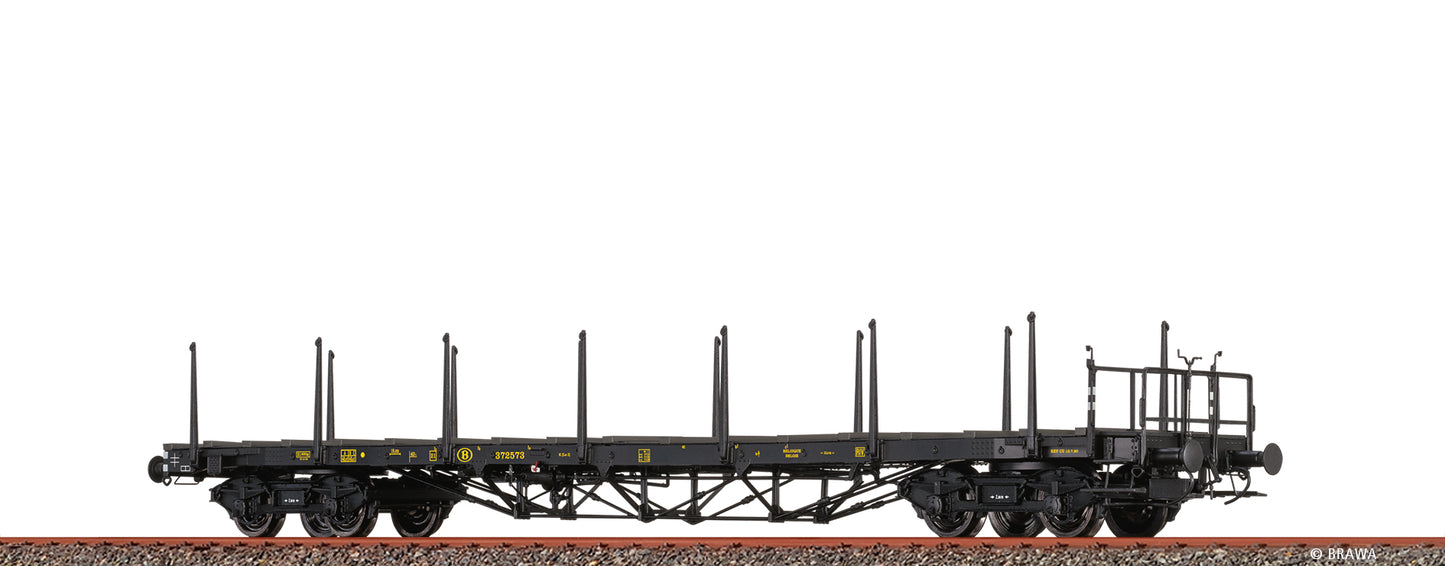
Brawa 51344 - H0 Heavy Duty Freight Car SSl SNCB


$0.00
Sale
Sold out
Regular price
Sale price
$000
Unit price
per
Shipping calculated at checkout.
Couldn't load pickup availability
Available to order, not in stock here (can email for estimate)
Scale: H0-Scale
EAN/UPC: 4012278513447
System: DC Analog.
Prototype
The railway has always been a means of transporting large and heavy loads. It was therefore a logical step for the K.E.P.V., after various predecessor designs, to devote itself to the development of rail carriages with larger payloads from around 1910. In accordance with the needs of the time, a rail carriage type was developed that was designed for a loading length of 18 m and a maximum load capacity of 35 t. In various construction lots between 1912 and 1928, the K.P.E.V. – and later the DRG – ordered a total of around 2,650 SSlm (Ce 168) rail carriages based on the Ce 168 master drawing. The filigree strut bracing and carriage floor made of perforated sheet metal were distinctive features of the rail carriages of this era. While most of these carriages were only equipped with handbrakes upon delivery, the units delivered to the DRB were factory fitted with Kunze-Knorr goods-train air brakes. These brakes were retrofitted to many carriages of older manufacture over the years. The vehicle fleet has fluctuated over the years. After the First World War, the total stock was decimated as a result of reparations to France and Belgium, as well as Poland. In the early 1950s, both German state railways still had a combined inventory of approximately 1,000 SSlm 16 / SSlu vehicles. Due to further decommissioning, the number of serviceable carriages fell steadily until the last wagons of this type were withdrawn from service in the 1970s.Brake blocks in wheel plane
NEM-standard short-coupling
Die-cast zinc floor
Insertable stakes, individually enclosed
Delivery without load
Extra mounted steps and handrails
Metal wheels
Finely detailed chassis
Extra mounted axle brake rod
Individually mounted toe bearing
Length over buffers: 231 mm
Kurzkupplungskinematik: eingebaut
EAN/UPC: 4012278513447