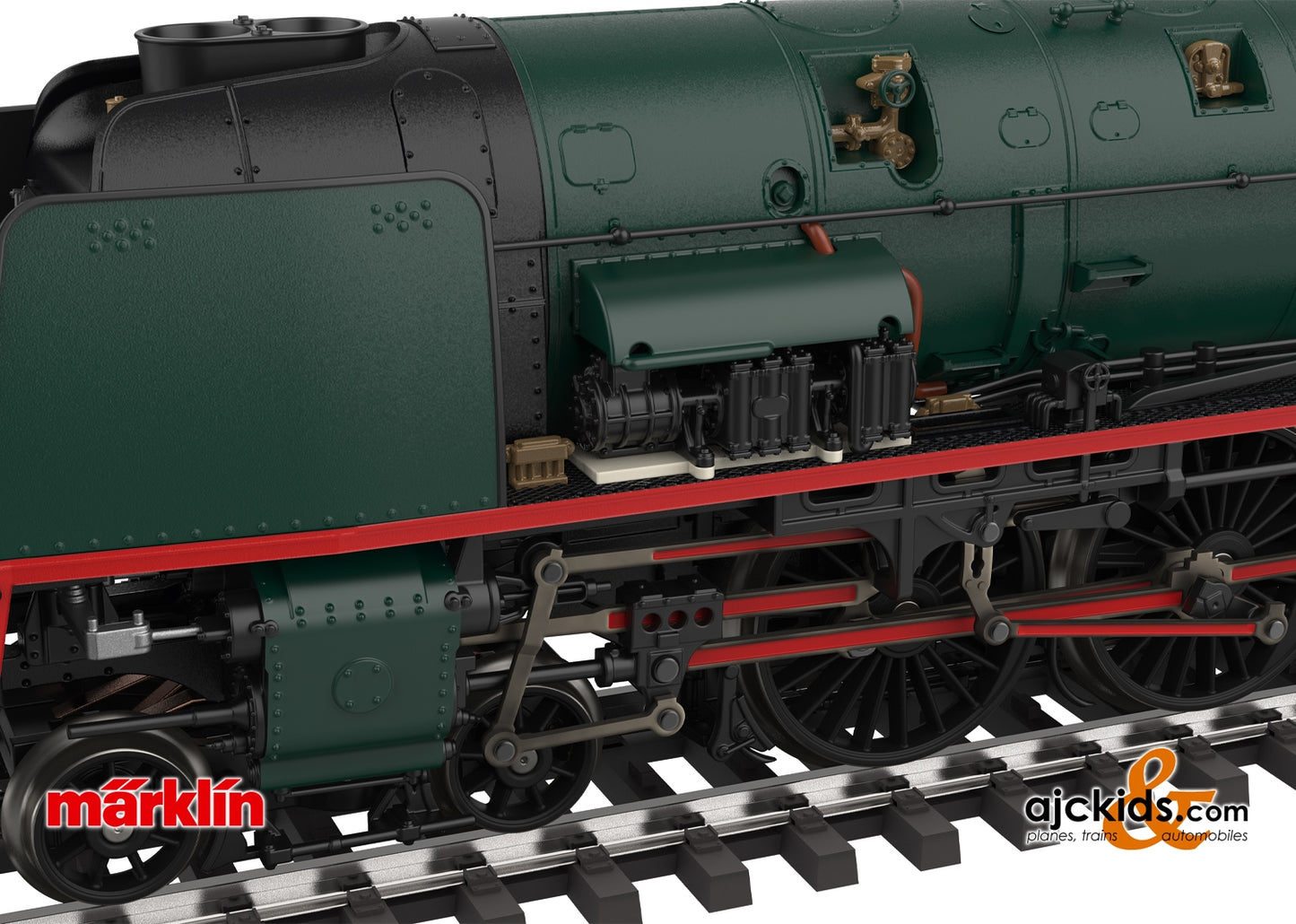
Marklin 39481 - Class 1 Steam Locomotive



Couldn't load pickup availability
Available to order, not in stock here (can email for estimate)
Scale: H0-Scale
EAN/UPC: 4001883394817
System: 3-Rail AC (Märklin).
Prototype: Class 1 express steam locomotive of the Belgian National Railways (SNCB/NMBS). Road number 1.002. Museum operating condition.
Highlights
- Prototypical tooling variations on the boiler. With buffer capacitors to bridge short unpowered sections of track.
- Dual headlights.
- It has a factory-installed smoke generator and speed-dependent, dynamic smoke exhaust.
- Cab lighting can be controlled separately in digital operation.
- Fire flickering in the firebox is digitally controllable.
- Numerous separately applied details.
- World of Operation mfx+ digital decoder with lighting and sound functions.
- The buffer height conforms to NEM specifications.
Product description
Model: The loco has an mfx+ digital decoder with lighting and sound functions. It also has a controlled high-performance motor with a flywheel, mounted in the boiler. One axle powered, two axles driven by coupling rods. Traction tires. The locomotive and tender are made mostly of metal. Factory-fitted smoke generator with speed-dependent, dynamic smoke exhaust. Dual headlights, digitally controllable. In addition, cab lighting and firebox flickering can be controlled separately in digital operation. Maintenance-free warm white and red LEDs are used for the lighting. With capacitor. Adjustable coupling with a guide mechanism between loco and tender. Tender has a close coupler with a guide mechanism and NEM pocket. The loco can safely negotiate curves with a radius of 437.5 mm / 17-1/4" (radius 2). Brake hoses, imitation screw couplers, and a signal holder are included. Length over buffers approximately 28.4 cm / 11-11/64".
Publications
In 1926, the “Chemins de fer de l’État belge” (Belgian State Railways) was renamed the “Société nationale des chemins de fer belges” (National Railway Company of Belgium or SNCB), which was subsequently translated as “Nationale Gesellschaft der Belgischen Eisenbahnen” in official Belgian German.
A DC version of this model is available in the Trix H0 range as item 25481.
Publications
- New items brochure 2026Prototype information
The Belgian National Railways class 1 express steam locomotive When they hear about “Belgian locomotives”, most railroad enthusiasts naturally think of the Nohab diesel locos, such as the famous “Kartoffelkäfer” (Colorado beetles), or possibly of one of the multi-system electric locos which sometimes traveled as far as Germany. But Belgian steam locos? Well, yes, after World War 1, large numbers of Prussian locos remained in Belgium, including members of the types P8, G8, and S9. But there were also steam locomotives designed and built in Belgium. One of these was the class 1, undoubtedly the pinnacle of Belgian steam locomotive construction. But first things first ... since the Belgian State Railways had received a large number of relatively new locomotives from Germany after the armistice of 1918, there was initially no need for new locomotives. Together with the class 10 delivered by 1912, these machines satisfied all requirements for train operations until well into the 1930s. However, increasing competition from automobiles and airplanes, as well as higher train weights – especially on the steep gradients between Brussels and Luxembourg – required an even more powerful loco. As a result, the first class 1 locomotive was delivered in 1935, which coincided with the centenary celebrations of Belgian railroads. It was delivered as a Pacific express locomotive with a 4-6-2 wheel arrangement.
The driving wheels were 1,980 mm / 78" in diameter, the idler wheels at the front 900 mm / 35-7/16" and at the rear 1,067 mm / 42". The external frame of the trailing truck was a characteristic feature made necessary due to the large grate and was reminiscent of American locomotives. They had four cylinders, but not in the compound configuration that was otherwise widely used in Europe. Instead, all four cylinders were supplied with live steam. Naturally, this had the advantage of ensuring high torque, good acceleration, and smooth running. It also eliminated the need for excessively large low-pressure cylinders. However, this was achieved at the cost of greater steam and coal consumption, which required a very large firebox that was even equipped with two fire doors. Indeed, on more arduous routes, two firemen were sometimes employed. Based on experience gained in France, a Kylchap induced drafting system with two blast pipes – and therefore also two smoke stacks – was installed. The design of the flow channels for the steam engine was also thermally optimized.
Unlike on German steam locos, the locomotive engineer on the Belgian locos stood on the left, so that the control rod was also located on the left side of the boiler. The solution for the valve gear of the inboard cylinders was interesting: Instead of installing a complete set of additional valve gear for each inboard cylinder, the motion of the slide valves for the inboard running gear was directed by the outboard running gear, which can be recognized from the rocking levers installed in front of the valve chests of the outboard cylinders to control the valves of the inboard cylinders. The frame was designed as a bar frame with cross-bearers of cast steel. The cylinder block was also a steel casting, or more precisely, two cast halves that were bolted together. Externally, the locomotives were immediately recognizable by their partially streamlined front end, the slanted upper edge of the smokebox door, and the large smoke deflectors. The streamlined cab and the boiler cladding, which was shaped to the boiler, also had a very modern look – most of the pipes were not mounted on the boiler, as in German locomotives, but under this cladding. Thus, the locomotive looked very elegant and smooth, although it had no streamlined fairing in the true sense of the word. A typical feature of this locomotive was the single headlight; it was a “single light headlight,” so to speak. The locos were subsequently modified and fitted with dual or even triple headlights.
The locos were coupled to a large tender that rolled on two two-axle trucks. It could hold 38 m³ / 10,038 US gallons of water and 10-1/2 metric tons / 11-1/2 short tons of coal – this was roughly the capacity of the five-axle tender for the German class 05 or 45. However, these locomotives, weighing 126 metric tons / 139 short tons without a tender, were very heavy. The axle load of up to 24 metric tons / 26 short tons was also a record for the time. With an output of 2,466 hp and a top speed of 120 km/h / 74 mph, the machines could fulfill all demands made of them and surpassed the performance of the predecessor class 10 by up to 40%, so that by 1938, a total of 35 of these impressive locomotives had been delivered by several Belgian locomotive factories. They soon took over all the important express train services on the main line between Ostend, Brussels, and Liège, as well as on the steeply graded routes to Aachen and Luxembourg. But the Second World War soon put an end to this, and they were then also used on less prestigious services. In the early 1950s, as life was gradually getting back to normal, the Belgian National Railways also began to procure diesel locos on a large scale, especially the 202 class, the famous NOHAB units. It wasn’t long before these new locomotives had taken over the most important express train services on the non-electrified routes. The main route from Ostend to Liège was fully electrified from 1955 onwards. As a result, the class 1 was very quickly relegated to lesser services, where it hauled domestic cars such as the typical M2 passenger cars instead of luxury express trains. The end came very quickly, and by 1962, all the locomotives in this class had been withdrawn. Only one survived: Road number 1.002 was preserved and even made operational again for the 150th anniversary celebrations of Belgian railroads in 1985. However, it is currently no longer in working order and is housed at the railroad museum “Chemins de Fer à Vapeur des trois Vallées” in Treignes in the south of Belgium near the French border. This means that we still have the opportunity today to admire one of the most extraordinary locos with its unusual technology, even if we can no longer experience it in action...
Features
Warning
| Control Unit | Mobile Station | Mobile Station 2 | Central Station 1/2 | Central Station 3/2 | |
|---|---|---|---|---|---|
| Headlight(s) | X | X | X | X | X |
| Smoke generator | X | X | X | X | X |
| Steam locomotive op. sounds | X | X | X | X | X |
| Locomotive whistle | X | X | X | X | X |
| Direct control | X | X | X | X | X |
| Sound of squealing brakes off | X | X | X | X | |
| Engineer’s cab lighting | X | X | X | X | |
| Flickering Light in Fire Box | X | X | X | X | |
| Whistle for switching maneuver | X | X | X | X | |
| Letting off Steam | X | X | X | ||
| Sound of coal being shoveled | X | X | X | ||
| Tipping grate | X | X | X | ||
| Air Pump | X | X | X | ||
| Water Pump | X | X | X | ||
| Injectors | X | X | X | ||
| Sanding | X | ||||
| Replenishing water | X | ||||
| Replenishing coal | X | ||||
| Replenishing sand | X | ||||
| Locomotive whistle | X | ||||
| Locomotive whistle | X |
EAN/UPC: 4001883394817