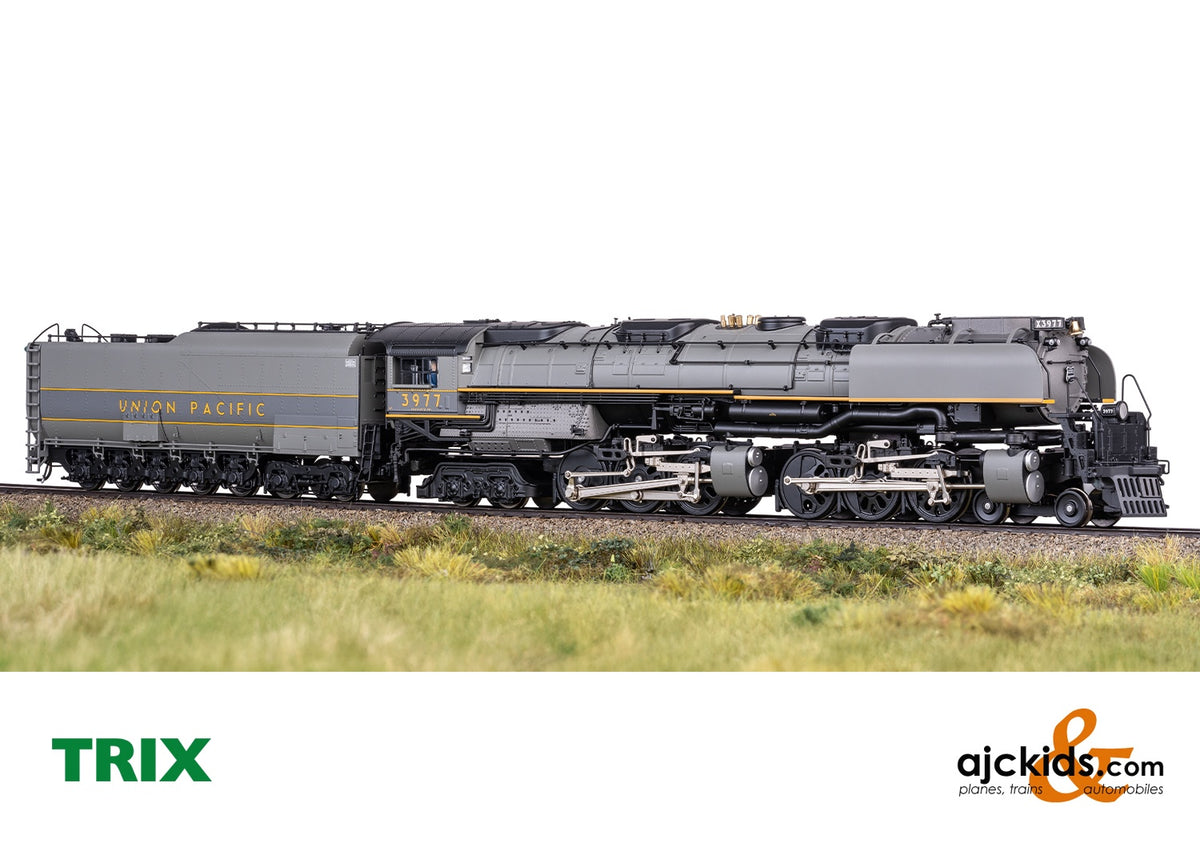
Trix 25913 − US Challenger Steam Loco, UP



Couldn't load pickup availability
Available to order, not in stock here (can email for estimate)
Scale: H0-Scale
EAN/UPC: 4028106259135
Prototype: Union Pacific Railroad (UP) class 3900 “Challenger” heavy American steam locomotive in the rebuilt version with an oil tender. The design replicates the prototype as it looks as a museum locomotive, road number 3977, in Cody Park in North Platte, NE. Eras III and VI.
Highlights
- Limited to 500 units worldwide.
- A numbered certificate of authenticity is included.
- Factory-installed, speed-dependent, dynamic smoke exhaust.
- Heavy metal construction with many separately applied details.
- Locomotive engineer and fireman figures in the engineer’s cab.
- Striking smoke deflectors.
- RailCom-enabled DCC/mfx digital decoder with extensive light and sound functions.
- A buffer capacitor to bridge short unpowered sections of track is fitted.
Product description
Model: With digital decoder and extensive light and sound functions. Different operating sounds, such as oil and water being replenished or the sounds of opening and closing the sliding windows and the ventilation hatch on the cab, can be controlled digitally. It also has a controlled high-performance motor with a flywheel, mounted in the boiler. Six axles are powered. Traction tires are fitted. The chassis is articulated to negotiate sharp curves. The model has Boxpok wheels. The loco and tender have headlights and backup lights. The headlights will work in conventional operation and can be controlled digitally. The cab lighting and the illuminated number boards/marker lights can be controlled separately in digital operation. Maintenance-free, warm-white LEDs are used for the lighting. A buffer capacitor is fitted. The factory-installed, speed-dependent, dynamic smoke exhaust can also be controlled digitally. There is a powerful speaker in the tender. An imitation coupler in a standard pocket can be mounted on the pilot at the front of the locomotive. There is a close coupling with a guide mechanism between the loco and tender. Steam lines on the front group of driving wheels are mounted to swing out and back with the cylinders. The metal handrails are separately applied, as are many other details. Figures of a locomotive engineer and fireman for the engineer’s cab are included. The locomotive is screwed to a presentation base to protect it during transport. Length over the couplers 42.5 cm / 16-3/4".
One-time series.
Publications
Notes for operation: Although the locomotive can be used on curved track with a radius of 360 mm / 14-3/16" or larger, we recommend larger radius curves. Due to the overhang of the long boiler, any signals, catenary masts, bridge handrails, tunnel portals, etc. must be installed in a way that ensures sufficient clearance on curves. Due to the high weight of the locomotive, the track must be firmly secured in position. The turntable and transfer table can be traversed by the locomotive but not turned or moved. Products bearing the wording “Union Pacific” are made under trademark license from the Union Pacific Railroad Company.
A matching US heavy-weight car set is available in the Trix H0 range as item 23729. An AC version of this model is available in the Märklin H0 range as item 39913.
Publications
- Fall New Items H0 2026Prototype information
The Union Pacific “Challenger” The first “Challenger” type steam locomotives entered service with the Union Pacific Railroad (UP). In the mid-1930s, UP chief engineer Arthur H. Fetter and Otto Jabelmann (UP superintendent of motive power) recognized that the existing steam locomotives were no longer capable of hauling heavier train loads at higher speeds. This was at a time when the company wanted to accelerate freight traffic chiefly on the 0.82% grades in Wyoming. In cooperation with the American Locomotive Company (ALCO), the two UP engineers developed an articulated steam loco with a 4-6-6-4 wheel arrangement. Although it adhered to the Mallet design, it did not operate using the compound principle but relied on simple steam expansion for each set of driving wheels. The first prototype bearing road number 3900 went into operation on August 25, 1936, in Council Bluffs, Iowa. This locomotive boasted the latest steam technology of the time, including roller bearings on all of the pilot/trailing wheel sets and on the tender wheels, a generously dimensioned boiler, as well as a suitably adapted combustion chamber. With a maximum speed of 70 mph /113 km/h, its main technical details were as follows: Boiler pressure 17.93 atmospheres / 263-1/2 pounds per square inch; four cylinders (558.8 x 812.8 mm / 22" x 32"); driving wheel diameter 1,752.6 mm / 69" (Boxpok wheels); grate surface 10.05 square meters / 108 square feet; heating surface 499 square meters / 5,371 square feet; super heater 151.1 square meters / 1,626 square feet; loco weight 256.5 metric tons / 292 short tons; adhesion weight 175 metric tons / 193 short tons; semi-Vanderbilt tender with two three-axle trucks. Its first test was hauling a heavy freight train from Ogden (Utah) to Green River (Wyoming), which involved overcoming the gradients of the Wasatch Mountains. To test the performance of this unit, the UP officials decided to run the locomotive without the assistance of an additional locomotive. Road number 3900 completed this task with flying colors, and Fetter thus declared that the new design had “met the challenge” with ease. As a result, the loco became known by the name “Challenger.” By 1937 the UP had placed 40 units bearing the numbers 3900-3939 (from 1944 on: 3800-3839) from three production batches into service. Of these, road numbers 3934-3939 were converted to oil firing immediately after delivery, followed by others over the next few years. Between 1942 and 1944, the UP further expanded its roster with an additional 65 “Challengers” (3930-3949, 3950-3969, and 3975-3999). With many improvements adopted from the “Big Boys” (such as more powerful boilers, roller bearings on all wheel sets, a larger cab), they were now referred to as “heavy” Challengers in contrast to the “light” Challengers from the years 1936/37. In 1945, road numbers 3975–3984 were converted to oil firing, followed in 1952 by road numbers 3930/31/32/34/37/38/43/44. In the same year, they were assigned new road numbers 3700–3707, while road numbers 3975–3984 became 3708–3717. Whereas the Challengers were initially used chiefly to haul freight trains over the gradients on the Wasatch Mountains and Sherman Hill, after the arrival of the even more powerful Big Boys, they were to be seen throughout the UP network in California, Nebraska, Oregon, Utah, and Wyoming. They were also sometimes used to pull passenger trains such as the “Challenger Streamliners” of the same name between Chicago and California. Due to the rapid pace of dieselization after World War II, the last “Challengers” were withdrawn from service in 1959. Just two locomotives were preserved – road number 3977 as a memorial in North Platte (Nebraska) and road number 3985, which was also converted to oil firing, as a UP museum locomotive that is currently non-operational.
Features
Warning
| DCC | SX2 | SX | MFX | |
|---|---|---|---|---|
| Headlight(s) | X | X | ||
| Smoke generator | X | X | ||
| Steam locomotive op. sounds | X | X | ||
| Locomotive whistle | X | X | ||
| Direct control | X | X | ||
| Sound of squealing brakes off | X | X | ||
| Bell | X | X | ||
| Grade crossing | X | X | ||
| Engineer’s cab lighting | X | X | ||
| Letting off Steam | X | X | ||
| Number Board Lights | X | X | ||
| Air Pump | X | X | ||
| Water Pump | X | X | ||
| Injectors | X | X | ||
| Light Function | X | X | ||
| Running gear lights | X | X | ||
| Sound of Couplers Engaging | X | X | ||
| Rail Joints | X | X | ||
| Cab Radio | X | X | ||
| Whistle for switching maneuver | X | X | ||
| Replenishing sand | X | X | ||
| Replenishing fuel | X | X | ||
| Replenishing water | X | X | ||
| Sanding | X | X | ||
| Operating sounds | X | X | ||
| Operating sounds | X | X | ||
| Operating sounds | X | X | ||
| Compressor | X | X | ||
| Auxiliary Blower | X | X |
EAN/UPC: 4028106259135